9 Best Smoke Detectors for Garages (November 2026)
The best smoke detectors for garages include the X-Sense Smoke Detector for most garages, the X-Sense Smoke Detector Carbon Monoxide Detector Combo for attached garages, and the Kidde Compact Smoke Detector for small garages.
On this page (9 sections)
- The best smoke detectors for garages
- How these garage smoke detectors compare
- How we compared these alarms
- Which sensor type suits a dusty garage?
- Should a garage alarm be wired or battery powered?
- How do you stop dust and exhaust setting off the alarm?
- Do you need carbon monoxide coverage in a garage?
- Where should the alarm go in a garage?
- The verdict: which smoke detector belongs in your garage?
The best type of smoke detector for garage conditions is a battery-powered photoelectric alarm, and the X-Sense SD2J0AX is the one to buy for most garages. Its sealed 10-year battery means no wiring a detached space, and its photoelectric sensor is the right match for the slow, smoky fires that piles of boxes and rags tend to start.
A garage is a harder home for an alarm than a hallway. Dust from tools and open shelves, exhaust from a warming car, and wide temperature swings all push a detector toward false alarms.
That changes which alarm belongs out there.
The rest of this guide sorts nine alarms by how well they handle those conditions. It covers wired and wireless linking to the house, carbon monoxide coverage for attached garages, and mounting tricks for ceilings you would rather not drill.
Our picks at a glance
-
1

-
2
 Best for attached garages
X-Sense Smoke Detector Carbon Monoxide Detector Combo
9.5/10 our score
See it on Amazon -
3

- 4
 Check it
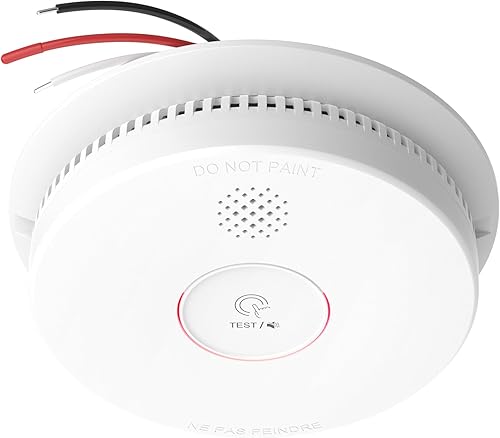
Siterlink Hardwired Interconnected Smoke Detectors
Best for linked coverage - 5
 Check it
First Alert SMI100-AC Hardwired Smoke Alarm 6-Pack
Best for whole-home wiring - 6
 Check it
FIRST ALERT BRK SC9120B Hardwired Smoke
Best for hardwired CO coverage - 7
 Best for set-and-forget battery powerCheck it
- 8
 Check it
SITERWELL Smoke Detector 10 Year Battery Smoke
Best for tool-free mounting - 9
 Check it
X-Sense Wireless Combination Smoke and CO Detector
Best for wireless linking
The best smoke detectors for garages
The X-Sense SD2J0AX takes the top spot for general garage use, and the picks below cover the specific cases it does not. Work out whether your garage is detached or attached, wired or not, and whether a car or fuel lives there before you pick.
X-Sense Smoke Detector: Best for most garages
- Photoelectric sensor
- Sealed 10-year lithium battery
- ETL listed to UL 217
- One-button test and hush
A no-wiring alarm with a battery that lasts the life of the unit, which suits a garage you only visit now and then.
Pros
- No electrician needed
- Photoelectric sensing
- One-button hush for dusty days
Cons
- Standalone only; alarms do not sound together
The X-Sense SD2J0AX fits a garage you visit to grab tools or park a bike, not one you sit in. Its sealed 10-year lithium battery means no outlet, no wiring and no yearly ladder climb to swap a cell.
The photoelectric sensor responds to the light-scattering smoke from smoldering cardboard, oily rags and dust-heavy clutter. It also helps cut the nuisance trips that plague garages, though a dusty workbench can still set it off now and then.
Mounting takes minutes with the included screws and anchors. The single button runs a self-test or hushes a false alarm, so you can silence a sawdust cloud without pulling the unit down.
The trade-off is that it stands alone. When it sounds in a detached garage, nobody inside the house hears it.
For linked alerts without wiring, look at the X-Sense wireless combo further down this list.
X-Sense Smoke Detector Carbon Monoxide Detector Combo: Best for attached garages
- Photoelectric smoke plus electrochemical CO sensing
- Sealed 10-year lithium battery
- LCD display
- UL 217 and UL 2034 certified
One unit covers smoke and carbon monoxide, a useful pairing for a garage where a car, generator or gas can sits near the house.
Pros
- Smoke and CO in one alarm
- Sealed 10-year battery
- LCD display
Cons
- Standalone; no wireless interconnection
An attached garage usually shares air with the house, which is why the SC07 earns a place here. It pairs a photoelectric smoke sensor with an electrochemical carbon monoxide sensor in one housing.
That matters when a car idles in the doorway or a gas can sits on a shelf. CO has no color or smell, so a smoke-only alarm leaves that hazard uncovered.
The LCD display gives you a readout to check at a glance.
The sealed lithium battery runs a full decade, which suits a garage where running power is a hassle. Mounting uses a bracket, screws and anchors, so no rewiring is needed.
The limit is the same as the top pick: it works alone. If the garage connects to sleeping rooms, the wireless linked version does more for you.
For general alarm selection, our guide on how to choose a smoke detector walks through sensor types and placement.
Kidde Compact Smoke Detector: Best for small garages
- 4-inch compact body
- Two AA batteries included
- Photoelectric sensor
- 10-year limited warranty
A small, light alarm that fits tight spots above a workbench or between shelves where a full-size unit crowds the ceiling.
Pros
- Smallest body here
- Batteries included
- Easy no-wiring setup
Cons
- AA batteries need replacing
- Not interconnectable
The Kidde 10SDR suits a tight garage where ceiling space is already spoken for. At 4 inches across and 1.88 inches deep, it slips between joists or above a shelf where a 5-inch round alarm would crowd things.
Kidde says the unit detects smoke over 25% faster than standard models, and its advanced sensing helps separate real smoke from cooking and steam. A garage sees less cooking than a kitchen, but dust and exhaust create the same kind of false signal.
Two AA batteries come in the box, so it works the moment you mount it. The red LED gives a clear visual warning, and the Test and Hush button lets you check it or silence a nuisance alarm.
The trade-off is battery upkeep. AA cells need replacing on a schedule, unlike the sealed 10-year units here.
That's a fair swap if you want the smallest footprint and don't mind a yearly check.
Siterlink Hardwired Interconnected Smoke Detectors: Best for linked coverage
- 120V AC hardwired with 9V backup
- Interconnected alarms
- One-touch silence up to 10 hours
- Photoelectric sensor
A wired alarm that sets off every linked unit at once, so a fire in the garage is heard inside the house.
Pros
- All linked alarms sound together
- Battery backup in outages
- Long silence mode
Cons
- Needs 120V wiring in the garage
- Sold as a single pack
The Siterlink GS562A is for a garage that already has 120V wiring and sits close enough to the house to matter. When one alarm trips, every linked unit sounds, so a fire in the garage wakes the bedrooms upstairs.
It runs on AC power with a 9V battery backup, so it keeps working through an outage or a tripped breaker. The photoelectric sensor and advanced sensing help keep cooking and dust alarms down.
The one-touch silence mode mutes a false alarm for up to 10 hours, which is handy when a dusty project sets it off. The hidden LED indicator stays soft enough not to bother anyone sleeping nearby.
The catch is installation. You need an electrician or existing alarm wiring in the garage, and this is a single pack.
If you're wiring a whole house at once, the First Alert six-pack covers more ground for the same effort.
First Alert SMI100-AC Hardwired Smoke Alarm 6-Pack: Best for whole-home wiring
- Six hardwired alarms
- 9V battery backup each
- Interconnectable up to 18 units
- Tamper-resistant locking pins
A multi-pack for wiring a garage into a house-wide alarm chain, with tamper pins that deter removal.
Pros
- Six units in one order
- Links up to 18 devices
- Tamper-resistant pins
Cons
- Ionization sensor reacts to flaming fires more than smoldering ones
- Needs AC wiring throughout
The First Alert SMI100-AC six-pack is the choice when you're wiring a garage as part of a larger job. One order covers the garage, the hall outside it and the rest of the house in a single interconnected chain.
Each unit runs on 120V AC with a 9V battery backup, and the chain links up to 18 devices, 12 of them smoke alarms. Tamper-resistant locking pins keep the units in place in a shared or rental property.
The ionization sensor reacts fastest to flaming fires that consume fuel quickly. That's a different strength from the photoelectric picks above, which lean toward smoldering smoke.
In a garage holding paint, solvents or fuel, the flaming-fire response has real value.
Two things to weigh: the wiring job is bigger than a battery alarm, and ionization sensors are more prone to nuisance trips near dust and exhaust. A linked system still earns its keep when the garage is under the same roof as the family.
FIRST ALERT BRK SC9120B Hardwired Smoke: Best for hardwired CO coverage
- Smoke and CO in one unit
- Hardwired with battery backup
- Ionization sensor
- Interconnectable with First Alert and BRK alarms
A wired smoke and carbon monoxide alarm for a garage that already has power and needs both hazards covered in one device.
Pros
- Smoke and CO together
- Battery backup
- Links with matching brands
Cons
- Ionization sensor only
- Single pack
The First Alert SC9120B brings smoke and carbon monoxide detection into one hardwired unit. It suits a garage with existing AC wiring where a car, generator or gas appliance sits near living space.
Its ionization sensor favors fast flaming fires, and the battery backup keeps it live during outages. It links with compatible First Alert and BRK alarms, so it can join an existing chain rather than stand apart.
The end-of-life warning tells you when the unit needs replacing, and the adapter helps with swapping out an older hardwired alarm. First Alert backs it with a 10-year limited warranty.
The trade-off is the sensor. Ionization alone is the weaker choice for smoldering garage clutter, so this works best as part of a mixed system rather than the only alarm out there.
The single pack also means one unit per order.
Kidde Smoke Detector: Best for set-and-forget battery power
- Built-in 10-year battery
- Photoelectric sensor
- LED status lights
- 85 dB alarm
A sealed-battery alarm with no chirping and no battery runs to the store, good for a garage used as long-term storage.
Pros
- Battery lasts the alarm's life
- Photoelectric sensing
- Standalone and simple
Cons
- Not interconnectable
- Larger than the compact Kidde
The Kidde 20SD10 fits a garage used mostly for long-term storage, where you want an alarm that needs nothing from you. Its built-in 10-year battery ends the low-battery chirp and the yearly battery run.
Kidde says the unit detects smoke over 25% faster than standard models and saves up to 40 dollars in battery replacements over its life. The advanced sensing helps filter cooking and steam, and the 85 dB alarm with red LED is loud enough to carry across a two-car space.
It's standalone and not interconnectable, so it covers the garage and only the garage. That's fine for a detached building.
For an attached garage, a linked alarm does more.
The body is 5 inches across and 2 inches deep, a bit larger than the compact Kidde above. Pick this one when set-and-forget simplicity beats a smaller footprint.
SITERWELL Smoke Detector 10 Year Battery Smoke: Best for tool-free mounting
- Built-in 3V lithium battery
- Magnet and screw mounting kit
- Photoelectric sensor
- Test and mute button
A slim alarm that comes with a magnetic fastening kit, so you can stick it to a steel shelf or beam without drilling.
Pros
- Magnetic mounting option
- Very slim body
- 10-year battery
Cons
- Magnet plate not guaranteed in every box
- Battery is not replaceable
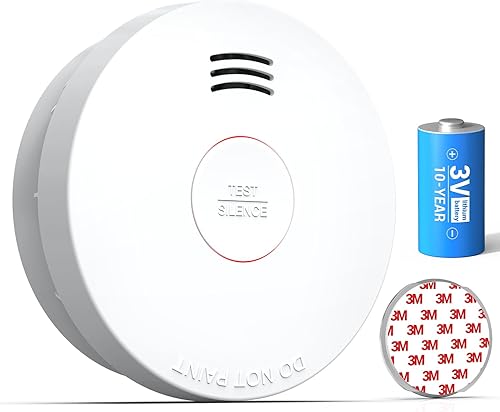
The SITERWELL GS525A solves a very garage-specific problem: mounting an alarm without drilling. It ships with a magnetic fastening kit alongside screws, so you can stick it to a steel beam or shelf in seconds.
Its photoelectric sensor is tuned for slow smoldering fires, and the optimized sensing algorithm filters out daily steam and smoke interference. That helps in a garage where dust and exhaust are constant background noise.
The built-in 3V lithium battery runs 10 years, and the test and mute button lets you check the unit or quiet a false alarm. The slim 1.38-inch body stays out of the way on a low ceiling.
Two caveats. The magnet plate isn't guaranteed in every box, so the screw option is the fallback.
And the battery isn't replaceable, so the whole unit goes when the battery ends. It's a fair pick for a metal-walled garage.
X-Sense Wireless Combination Smoke and CO Detector: Best for wireless linking
- Wireless interconnection, no Wi-Fi needed
- Smoke and CO in one alarm
- 10-year sealed lithium battery
- Oversized 5.7-inch bracket
A battery alarm that talks to its partners over radio, so a garage alert also sounds in the house without any wiring.
Pros
- Linked alerts without wiring
- Smoke and CO together
- Big bracket covers old holes
Cons
- No Wi-Fi or app alerts
- Needs matching X-Sense units to link
The X-Sense XP0H-WN is the pick for an attached garage where you want linked alerts but no electrician. It uses radio interconnection, so when one alarm trips, every paired unit sounds, all without Wi-Fi or a base station.
It combines photoelectric smoke sensing with electrochemical carbon monoxide detection, covering both hazards a garage can produce. The sealed 10-year battery means no wiring and no battery swaps.
The oversized 5.7-inch bracket covers old screw holes and ceiling marks from a previous alarm, so swapping out an old unit leaves a clean ceiling. It's ETL listed to UL 217 and UL 2034.
The catch is that you need matching X-Sense units to build the network, and there's no app or remote alert. It's also the lowest score here, because it costs more complexity than a standalone alarm for the same basic job.
Buy it when linking to the house is the point.
How these garage smoke detectors compare
Every alarm here detects smoke. The differences that matter in a garage come down to power, sensor type, linking and how much maintenance each one asks of you.
| Product | Best for | Power | Sensor | Size | Our score |
|---|---|---|---|---|---|
| X-Sense Smoke Detector | most garages | Battery powered | Photoelectric | 4.8 x 4.8 x 1.8 in | 9.6 |
| X-Sense Smoke Detector Carbon Monoxide Detector Combo | attached garages | 10-year sealed battery | Photoelectric and electrochemical | 5.7 x 5.7 x 2 in | 9.5 |
| Kidde Compact Smoke Detector | small garages | AA battery | Photoelectric | 4 x 4 x 1.88 in | 9.4 |
| Siterlink Hardwired Interconnected Smoke Detectors | linked coverage | Hardwired with 9V backup | Photoelectric | 9.1 | |
| First Alert SMI100-AC Hardwired Smoke Alarm 6-Pack | whole-home wiring | 120V AC with 9V backup | Ionization | 8.8 | |
| FIRST ALERT BRK SC9120B Hardwired Smoke | hardwired CO coverage | AC/DC | Ionization | 8.7 | |
| Kidde Smoke Detector | set-and-forget battery power | 10-year battery | Photoelectric | 5 x 5 x 2 in | 8.7 |
| SITERWELL Smoke Detector 10 Year Battery Smoke | tool-free mounting | 10-year sealed battery | Photoelectric | 3.93 x 3.93 x 1.38 in | 8.5 |
| X-Sense Wireless Combination Smoke and CO Detector | wireless linking | 10-year sealed battery | Photoelectric and electrochemical | 8.2 |
How we compared these alarms
We checked the specs and features of each alarm against what a garage actually throws at it: dust, exhaust, temperature swings and the odds of the space being detached. Sensor type carried the most weight, since photoelectric sensing handles smoldering clutter fires and false-alarm resistance better than ionization alone.
Power came next. A sealed 10-year battery wins for a detached garage with no wiring, while a hardwired unit wins when the garage sits under the same roof as sleeping rooms.
Linking decided the rest: an alarm that sets off the house units is worth more in an attached garage than a standalone that only the garage hears.
We also weighed mounting hardware, silence controls and whether the unit covers carbon monoxide. Our score weighs specs, features and buyer feedback against what you're shopping for.
Prices and review counts played no part.
Which sensor type suits a dusty garage?
Photoelectric is the better sensor for a garage, because it reacts to the light-scattering smoke from smoldering materials and resists dust and steam better than ionization. Most garages store exactly the kind of slow-burning clutter photoelectric sensing handles well.
Ionization sensors react fastest to flaming fires. That's a real strength in a garage holding paint, solvents or fuel, but the same sensor trips more easily on dust and exhaust.
The First Alert SMI100-AC and SC9120B both use ionization.
The practical answer for many garages is a photoelectric alarm as the main unit, with an ionization unit added if the space stores flammables. If you already run ionization alarms indoors and want the same sensing throughout, matching them has value too.
Our roundup of the best smoke detectors for kitchens covers how photoelectric units handle steam-heavy rooms.
Photoelectric alarms
These pick up smoldering smoke from cardboard, rags and insulation. They also produce fewer false alarms near dust.
Pick one for a general-purpose garage.
Ionization alarms
These respond quickly to flaming fires. They suit a garage with fuel, solvents or a workshop.
Expect more nuisance trips unless the unit stays clear of dust sources.
Combination and multi-criteria units
A combo pairs smoke sensing with carbon monoxide, or mixes sensor types in one housing. These suit an attached garage where you want fewer devices on the ceiling.
Should a garage alarm be wired or battery powered?
Start with your wiring. If the garage already has 120V alarm wiring from a previous unit, a hardwired alarm is the simpler swap.
If it doesn't, a battery alarm saves you the electrician and the permit.
A hardwired unit with battery backup keeps working through outages and links into a house-wide chain. That's the strongest setup for an attached garage, because a fire in the garage sounds in the bedrooms at the same time.
Battery alarms are easier and cheaper to install, and a sealed 10-year cell means almost no upkeep. The weakness is that a standalone battery unit only alerts the garage.
If the garage is detached and far from the house, that may be all you need.
Wireless interconnection splits the difference. The X-Sense XP0H-WN runs on batteries but still links its alerts across units.
Pick hardwired if the wiring exists, wireless if it doesn't and you want linked coverage anyway.
How do you stop dust and exhaust setting off the alarm?
Placement does most of the work. Keep the alarm at least 10 feet from a car's exhaust path and away from the dustiest tools.
A unit mounted right over a saw or grinder will trip on every project.
Mount it on the ceiling or high on a wall, following the maker's instructions for distance from walls and corners. Avoid the spot directly above a doorway to the house, where exhaust and cooking fumes drift through.
Choose a model with a hush button. The X-Sense SD2J0AX, the Kidde units and the Siterlink all offer one-button silence, so a false alarm takes a second to clear rather than a ladder climb.
The Siterlink's silence runs up to 10 hours.
Keep the sensor face clean. A quick vacuum or wipe on a schedule removes the dust film that makes false alarms more likely.
If nuisance alarms persist after cleaning and repositioning, a heat alarm is the usual alternative in a very dusty workshop.
Do you need carbon monoxide coverage in a garage?
Yes, if a car, generator or gas appliance sits in or near the garage. Carbon monoxide has no color or smell, so a smoke-only alarm leaves that risk uncovered.
An attached garage is the highest-priority spot for a combo unit.
The X-Sense SC07 covers both hazards on a sealed 10-year battery. The First Alert SC9120B does the same on hardwired power with battery backup.
Either one puts two sensors where a garage's two main risks are.
A detached garage used only for storage and bikes needs less. A smoke alarm alone is the sensible minimum there, and the top pick covers it without wiring.
If you already have CO alarms inside the house and the garage is detached, a smoke-only unit is enough. Save the combo for the garage that shares a wall or a door with living space.
For sleeping areas, our guide to the best type of smoke detector for a bedroom covers placement near where people sleep.
Where should the alarm go in a garage?
One alarm on the ceiling near the center covers a typical one- or two-car garage. Put it where smoke can reach it before it fills the space, and keep it clear of the door and any dust-producing bench.
Follow the maker's spacing for walls and corners, usually at least 4 inches from a wall. For a long or L-shaped garage, or one split by a wall, add a second unit so a fire at the far end isn't missed.
Heat rises, so the ceiling is the right surface for smoke alarms in most cases. If your garage ceiling is unfinished or metal, a magnetic mount like the SITERWELL's helps avoid drilling.
Test each alarm weekly with its test button, and replace the whole unit when the maker's end-of-life signal sounds. A 10-year sealed battery runs out at the same time as the sensor, which is why those units are replaced rather than re-battered.
Our roundup of the best battery-operated smoke detectors compares sealed-battery options across the house.
The verdict: which smoke detector belongs in your garage?
For most garages, buy the X-Sense SD2J0AX. It's battery powered with a sealed 10-year cell, so no wiring job, and its photoelectric sensor suits the smoldering clutter a garage tends to hold.
The hush button handles the odd dusty false alarm.
Pick the X-Sense SC07 combo if the garage is attached or holds a car, generator or gas can. Choose the Siterlink or the First Alert six-pack when the garage has AC wiring and you want alerts to reach the house.
For wireless linking without an electrician, the X-Sense XP0H-WN does the job.
The best type of smoke detector for garage use comes down to one question: does anyone inside the house need to hear it? If yes, go linked.
If not, the top pick covers the space on its own for a decade.
Our top 3 picks at a glance
-
1
-
2
Best for attached garages
X-Sense Smoke Detector Carbon Monoxide Detector Combo
9.5/10 our score
See it on Amazon -
3
Frequently asked questions
Can I put a regular smoke detector in my garage?
Yes, but pick a photoelectric model and expect more nuisance alarms than in a hallway. Dust, sawdust, car exhaust and temperature swings all push a garage alarm harder than a living-room unit.
A heat alarm is the usual alternative where dust is heavy.
Should a garage smoke alarm be interconnected to the house?
It helps when the garage is attached. A linked alarm sounds inside the house at the same time, so sleeping family members hear it.
That means hardwired units or a wireless model like the X-Sense XP0H-WN, not a standalone alarm.
Do garages need carbon monoxide alarms too?
A garage that houses a car, generator or gas equipment is a strong place for carbon monoxide coverage. A combo unit like the X-Sense SC07 or the First Alert SC9120B covers smoke and CO in one device.
CO is invisible, so the extra sensor matters.
How many smoke alarms does a garage need?
One alarm covers a typical one- or two-car garage. Add a second unit if the space is split by a wall or holds a workshop area far from the first.
Place it on the ceiling or high on a wall, away from the door and any dust-producing tool.
Are 10-year battery alarms better for garages?
Often, yes. A sealed 10-year battery skips the wiring job and the yearly ladder climb, which matters in a garage that's cold in winter.
The catch is that you replace the whole alarm when the battery ends, not just the cell.


