9 Best Smoke Detectors for Bedrooms (November 2026)
The best smoke detectors for bedrooms include the BRK First Alert 9120BFF/ SMI100-AC Smoke Detector for hardwired homes, the X-Sense Smoke Detector for low maintenance, and the X-Sense Smoke Detector Carbon Monoxide Detector Combo for covering CO too.
On this page (8 sections)
- Which smoke detector fits your bedroom?
- How these bedroom detectors were compared
- What type of smoke detector works best in a bedroom?
- Should a bedroom detector be hardwired or battery powered?
- Where should a bedroom smoke detector go?
- Do bedroom alarms need to be interconnected?
- What about carbon monoxide in bedrooms?
- Which bedroom smoke detector should you buy?
The best smoke detector for a bedroom in most homes is the BRK First Alert 9120BFF, because hardwired 120V power keeps it always on and a 9V backup covers outages. If your ceiling has no wiring, the X-Sense SD2J0AX is the strongest battery pick with its sealed 10-year cell and photoelectric sensor.
Bedrooms are where a detector matters most, because that's where people sleep through the first minutes of a fire. The best type of smoke detector for bedroom use balances two things: a sensor that responds to smoldering fires without crying wolf over steam, and a power source that won't quietly die.
Our picks at a glance
-
1
 Best for hardwired homes
BRK First Alert 9120BFF/ SMI100-AC Smoke Detector
9.7/10 our score
See it on Amazon -
2

-
3
 Best for covering CO too
X-Sense Smoke Detector Carbon Monoxide Detector Combo
9.5/10 our score
See it on Amazon
- 4
 Best for linked whole-home coverageCheck it
- 5
 Best for small roomsCheck it
- 6
 Check it
FIRST ALERT BRK SC9120B Hardwired Smoke
Best for combo smoke and CO - 7
 Check it
SITERWELL Smoke Detector 10 Year Battery Smoke
Best for budget sealed battery - 8
 Check it
SITERLINK Smoke Detectors with 9V Replaceable
Best for replaceable battery fans - 9
 Check it
Kidde 30CUDR AA Battery Smoke and CO Alarm
Best for battery-powered combos
Which smoke detector fits your bedroom?
The right choice depends on your wiring, your tolerance for battery chores and whether carbon monoxide is a concern in the room. Each pick below is the best fit for one of those situations.
Our score weighs specs, features and buyer feedback against what you're shopping for.
BRK First Alert 9120BFF/ SMI100-AC Smoke Detector: Best for hardwired homes
- 120V AC hardwired with 9V battery backup
- Ionization sensor for fast flaming fires
- Interconnects with up to 12 BRK or First Alert alarms
- 85 dB alarm
Hardwired power with battery backup keeps a bedroom alarm running through outages. It links with other compatible BRK and First Alert units so the whole house sounds together.
Pros
- Stays powered without battery changes
- 9V backup covers power failures
- Interconnects with up to 12 alarms
Cons
- Needs existing AC wiring and a junction box
- Ionization sensor reacts to cooking smoke
The 9120BFF is the overall pick because it solves the two failure modes that matter most in a bedroom: dead batteries and power cuts. Hardwired 120V AC keeps the unit live, and a 9V backup takes over when the circuit drops.
At 5.6 inches across and 2.2 inches tall, it fits a standard ceiling spot without crowding the room.
Its ionization sensor reacts quickly to flaming fires, the kind that spread from a kitchen or a space heater. An 85 dB horn is loud enough to wake most sleepers, and the unit links with up to 12 compatible BRK or First Alert alarms so every bedroom sounds at once.
A latching indicator also marks which unit first triggered, so you know where the trouble started.
A single test and silence button handles checks and nuisance alarms. Side-load battery access and a tamper-resistant bracket simplify installation, and the gasket-less mount aligns without fuss.
It's rated for 10 to 95% relative humidity and backed by a 10-year limited warranty.
The trade-off is wiring: this unit needs an existing AC box at the mount point. In a house without that, a battery model here is the easier path.
X-Sense Smoke Detector: Best for low maintenance
- Sealed 10-year lithium battery
- Photoelectric sensing for fewer cooking nuisance alarms
- ETL listed to UL 217
- One-button hush and self-test
A sealed battery means no replacements for a decade. Photoelectric sensing suits bedroom hallways where steam and cooking fumes are a nearby concern.
Pros
- No battery changes for 10 years
- Photoelectric sensor resists cooking false alarms
- No wiring or electrician needed
Cons
- Sealed battery cannot be replaced
- Works alone, with no wireless linking
The SD2J0AX is the best bedroom alarm for anyone who never wants to climb a ladder with a 9V cell. Its sealed lithium battery runs up to 10 years, which removes the low-battery chirp that so often gets silenced at 2 a.m.
At 4.8 inches wide and 1.8 inches thick, it's smaller than the hardwired BRK and easier to fit over a narrow ceiling spot.
Photoelectric sensing responds to slow, smoldering fires and shrugs off everyday cooking fumes and steam. That matters in a bedroom near a kitchen or a bathroom door.
The unit is ETL listed to UL 217 and gives a loud local alert with an LED indicator. Its ABS housing is rated for 10 to 85% humidity.
Installation takes minutes with the included screws and anchors, no wiring or electrician needed. One button runs self-tests and hushes nuisance alarms.
The box holds the alarm, the sealed battery already inside and the hardware, so there's nothing extra to buy.
The trade-off against the BRK is standalone operation: no Wi-Fi, app alerts or wireless linking. For a single bedroom that's fine.
For whole-home coverage where every alarm sounds together, the hardwired interconnected units here do more.
X-Sense Smoke Detector Carbon Monoxide Detector Combo: Best for covering CO too
- Photoelectric smoke and electrochemical CO sensors
- Sealed 10-year lithium battery
- Meets UL 217 and UL 2034
- 85 dB alarm
One unit handles smoke and carbon monoxide in a bedroom or its hallway. A sealed battery removes the yearly ladder climb.
Pros
- Smoke and CO detection in one unit
- No battery replacements for 10 years
- Photoelectric sensor helps with cooking fumes
Cons
- No wireless interconnection or app alerts
- CO sensing does not replace a whole-home plan
The SC07 adds carbon monoxide detection to the bedroom job. A photoelectric smoke sensor handles smoldering fires and cooking fumes, while an electrochemical CO sensor watches for the colorless gas that can build up from a furnace, water heater or attached garage.
A sealed 10-year lithium battery powers both sensors, so there are no battery swaps and no midnight chirps. The unit meets UL 217 and UL 2034, and its 85 dB alarm is loud enough for a closed bedroom door.
At 5.7 inches across and 2 inches tall, it's close in size to the hardwired BRK, so it fits the same kind of ceiling space.
Mounting needs no rewiring: a bracket, screws and anchors are in the box. The housing uses heat-resistant PC plastic, and the status lights give you a quick read on the unit's state.
The trade-off is that it runs alone. No wireless interconnection means it won't trigger other alarms in the house.
For a bedroom above a garage or beside a furnace closet, the extra CO coverage still earns its spot.
SITERWELL Smoke Detector: Best for linked whole-home coverage
- 120V hardwired with 9V backup battery
- Photoelectric sensor
- Interconnects up to 12 detectors
- Meets UL 217 10th Edition
Photoelectric sensing in a hardwired package gives bedrooms fewer nuisance alarms than an ionization unit. Linking up to 12 detectors covers the whole house.
Pros
- Hardwired power with battery backup
- Photoelectric sensor reduces cooking false alarms
- Links up to 12 units
Cons
- Requires AC wiring at the mount point
- Fault signals need attention
This SITERWELL unit pairs a photoelectric sensor with hardwired 120V power, which is a useful mix for a bedroom where steam is a nearby nuisance. Photoelectric sensing targets smoldering fires and filters out much of the cooking and shower interference that trips ionization alarms.
The 9V backup battery keeps the alarm live through outages and circuit failures. Hardwired interconnection links up to 12 detectors, so a fire in one room wakes the whole house.
The unit is slim at 1.5 inches tall and 5.68 inches wide, so it sits close to the ceiling.
An 85 dB alarm and a flashing red LED give audio and visual warnings. The test and silence button handles weekly checks and lets you mute a low-battery chirp for 10 hours.
The housing meets UL 217 10th Edition and uses flame-retardant polycarbonate, and the unit is rated for 10 to 95% humidity.
The trade-off is the same as the BRK: it needs AC wiring at the mount. If your bedroom ceiling has a box already, this is the photoelectric alternative to the overall pick.
Kidde Compact Smoke Detector: Best for small rooms
- Four-inch compact housing
- Two AA batteries included
- Photoelectric sensing with reduced false alarms
- Meets UL 217 10th Edition
The small housing fits narrow ceiling spots and tight bedroom corners. AA batteries make changes quick without special cells.
Pros
- Compact 4-inch size
- AA batteries are easy to replace
- Photoelectric sensor reduces false alarms
Cons
- Batteries need routine replacement
- Works alone, with no linking
Kidde's 10SDR is the best fit for small bedrooms and tight ceiling spots. The housing is just 4 inches across and 1.88 inches deep, so it tucks into narrow soffits and low-clearance ceilings where a 5.6-inch round alarm would crowd the space.
It runs on two AA batteries, included, and needs no wiring. Photoelectric sensing helps separate real smoke from cooking and steam.
The 85 dB alarm comes with a red LED for visual warnings. The plastic housing is rated for humidity up to 95% non-condensing.
Kidde says the model detects smoke over 25% faster than a comparison set of earlier units, and the unit meets UL 217 10th Edition and FCC standards. A 10-year limited warranty covers the alarm from the purchase date.
The box includes the two AA batteries, the mounting hardware and a user guide.
The trade-off is battery maintenance: AA cells need periodic replacement, unlike the sealed 10-year units here. For a compact room where fit is the deciding factor, that's a fair swap.
FIRST ALERT BRK SC9120B Hardwired Smoke: Best for combo smoke and CO
- Smoke and carbon monoxide in one unit
- Hardwired with battery backup
- Ionization sensor
- Interconnects with First Alert and BRK alarms
A hardwired two-in-one that watches smoke and carbon monoxide from the same ceiling spot. Linking with compatible alarms spreads the warning through the home.
Pros
- Two-in-one smoke and CO protection
- Hardwired with backup battery
- Interconnects with compatible alarms
Cons
- Ionization sensor reacts to cooking smoke
- Needs existing AC wiring
The SC9120B covers smoke and carbon monoxide from one hardwired unit. Its ionization sensor targets fast flaming fires, and the backup battery keeps both sensors running when the power fails.
The unit interconnects with compatible First Alert and BRK alarms.
For a bedroom beside a furnace closet, an attached garage or a gas appliance, the two-in-one design means one ceiling spot covers both hazards. An end-of-life warning tells you when the sensing element needs replacing.
The unit measures 5.6 inches wide and 1.9 inches deep, the same footprint class as the BRK 9120BFF.
Installation is a direct swap for many existing hardwired alarms, and a 10-year limited warranty backs the unit. The alkaline backup battery, mounting bracket and user manual are all in the box.
The trade-off against the BRK 9120BFF is the sensor type: ionization is more prone to cooking smoke than the photoelectric units here. In a bedroom far from the kitchen that rarely matters.
Near one, the SITERWELL or X-Sense picks handle fumes more calmly.
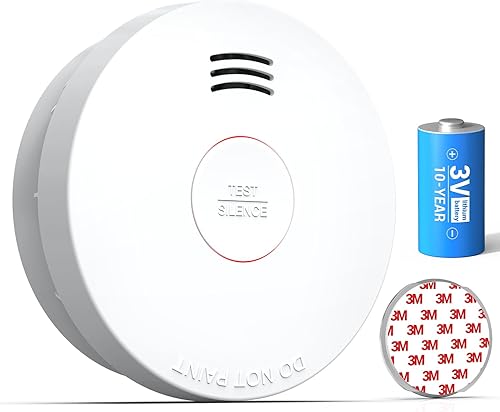
SITERWELL Smoke Detector 10 Year Battery Smoke: Best for budget sealed battery
- Built-in 3V lithium battery for 10 years
- Photoelectric sensor
- Test and mute button
- Magnet or screw mounting
A low-cost sealed-battery alarm for a spare room or rental. Photoelectric sensing and a mute button keep everyday fumes from setting it off.
Pros
- Sealed 10-year battery
- Photoelectric sensor reduces false alarms
- Magnet or screw mounting
Cons
- Battery cannot be replaced
- Works alone, with no linking
The GS525A is the budget route to a sealed battery. Its built-in 3V lithium cell runs 10 years, so there are no replacements and no chirps until the unit reaches its end.
Photoelectric sensing and an optimized algorithm filter out daily steam and cooking smoke.
It meets UL 217, and the test and mute button covers weekly checks. The 85 dB alarm carries through a closed door.
Mounting is flexible: a magnet plate or screws work on walls and ceilings, though some units may ship without the magnet plate. At 3.93 inches across and 1.38 inches thick, it's the smallest alarm in this roundup.
The trade-off is that the sealed cell can't be swapped. When the unit signals its end, you replace the whole alarm.
That's normal for 10-year sealed models, but it means buying again rather than changing a battery. For a spare room or rental, the low cost and simple install make sense.
SITERLINK Smoke Detectors with 9V Replaceable: Best for replaceable battery fans
- Replaceable 9V battery
- Photoelectric sensor
- One-button mute up to 10 hours
- Sticker or screw mounting
A conventional battery alarm for people who prefer swapping a 9V cell on their own schedule. The long mute helps when a false alarm fires at night.
Pros
- Replaceable 9V battery
- 10-hour mute function
- Mounts with sticker or screws
Cons
- Battery needs periodic replacement
- Works alone, with no linking
The GS509A suits anyone who prefers a battery they can replace themselves. A 9V cell sits in the unit and swaps without tools, so you can keep a spare on hand and change it on your own schedule.
The package includes the battery.
Its dual light wave detection judges whether smoke comes from a real fire and learns to compensate for temperature, humidity and dust changes. The one-button mute holds for 10 hours, which helps when a false alarm fires while you're asleep or when a low-voltage chirp starts.
Installation takes seconds with the included 3M sticker or screws, anchors and a mounting bracket. At 3.92 inches wide and 1.4 inches thick, it's compact enough for small rooms.
The 85 dB alarm is loud enough for most bedrooms.
The trade-off is routine battery care, plus the unit works alone with no interconnection. Pick it for a simple, self-managed bedroom alarm over the sealed-battery models.
Kidde 30CUDR AA Battery Smoke and CO Alarm: Best for battery-powered combos
- Smoke and carbon monoxide detection
- Two AA batteries included
- Photoelectric and electrochemical sensors
- Meets UL 217 and UL 2034
A two-in-one battery alarm for bedrooms without wiring. It covers smoke and carbon monoxide from one unit but needs battery swaps.
Pros
- Smoke and CO in one battery unit
- AA batteries are easy to find
- Photoelectric sensor reduces false alarms
Cons
- Batteries need routine replacement
- Works alone, with no linking
Kidde's 30CUDR brings smoke and carbon monoxide detection to a battery-powered unit. Two AA batteries, included, mean no wiring and no electrician, so it drops into a bedroom ceiling in minutes.
At 5 inches across and 1.88 inches deep, it's slightly slimmer than the compact 10SDR.
Its photoelectric sensor handles smoldering fires and filters out cooking and steam interference. The electrochemical CO sensor covers carbon monoxide, and the 85 dB alarm with a red LED gives audio and visual warnings.
Kidde says smoke detection runs over 25% faster than comparison units, and the alarm meets UL 217 10th Edition and UL 2034 5th Edition. The plastic housing is rated for 10 to 95% humidity.
A 10-year limited warranty starts from the purchase date. The trade-off is battery changes and standalone operation: no linking with other alarms.
It's the simplest way to add CO coverage to a bedroom without wiring.
How these bedroom detectors were compared
We compared the specs that decide how a bedroom alarm behaves on a normal night: sensor type, power source and backup, interconnect support, alarm loudness, certifications and warranty terms. Sensor type came first because it drives both detection speed and false-alarm frequency.
Power came next. Hardwired units with backup get priority for rooms that already have wiring, while sealed 10-year batteries win where battery chores are the reason alarms go dead.
Interconnect support broke ties for households that want every bedroom to sound together. Alarm loudness sat near 85 dB on almost every pick, so it separated fewer units than sensor type did.
We also weighed what each unit covers: smoke alone, or smoke plus carbon monoxide. Scores reflect how well each pick serves a bedroom's specific needs, not a lab ranking.
If you're still mapping out your home's coverage, our guide on how to choose a smoke detector walks through types and placement room by room.
| Product | Best for | Power | Sensor | Warranty | Our score |
|---|---|---|---|---|---|
| BRK First Alert 9120BFF/ SMI100-AC Smoke Detector | hardwired homes | 120V AC with 9V backup | Ionization | 10-year limited | 9.7 |
| X-Sense Smoke Detector | low maintenance | Sealed 10-year battery | Photoelectric | 9.6 | |
| X-Sense Smoke Detector Carbon Monoxide Detector Combo | covering CO too | Sealed 10-year battery | 9.5 | ||
| SITERWELL Smoke Detector | linked whole-home coverage | 120V AC with 9V backup | Photoelectric | 9.4 | |
| Kidde Compact Smoke Detector | small rooms | Two AA batteries | Photoelectric | 10-year limited | 9.4 |
| FIRST ALERT BRK SC9120B Hardwired Smoke | combo smoke and CO | AC/DC hardwired with backup | 10-year limited | 8.7 | |
| SITERWELL Smoke Detector 10 Year Battery Smoke | budget sealed battery | Built-in 10-year lithium | Photoelectric | 8.5 | |
| SITERLINK Smoke Detectors with 9V Replaceable | replaceable battery fans | Replaceable 9V battery | Photoelectric | 8.0 | |
| Kidde 30CUDR AA Battery Smoke and CO Alarm | battery-powered combos | Two AA batteries | 10-year limited | 7.7 |
What type of smoke detector works best in a bedroom?
The best type of smoke detector for bedroom safety is a photoelectric model with backup power. Photoelectric sensors respond to smoldering fires and tolerate steam and cooking fumes better than ionization units, which cuts the false alarms that make people pull batteries.
Ionization sensors aren't wrong for bedrooms, though. They react faster to flaming fires.
A home with both sensor types across its alarms covers more fire patterns than one type alone. If you want the deep comparison, our piece on smoke alarm vs smoke detector explains the naming and the hardware differences.
Photoelectric for sleeping areas
Photoelectric is the safer default for bedrooms and the hallways outside them. It senses the light smoke that smolders for hours before flames appear, which is the fire pattern that most often kills people while they sleep.
It's also the sensor that stays quiet when someone takes a hot shower.
Ionization for flaming fires
Ionization responds quickly to open flames and fast-burning materials. Put it in a bedroom only if the room sits far from the kitchen and bathroom.
Near either, a photoelectric unit here will annoy you less. The BRK 9120BFF and First Alert SC9120B are the two ionization picks, and both earn their place in rooms away from cooking.
Dual-sensor models
Some alarms combine both sensor types. None of the picks in this roundup carry a dual sensor, so a mixed setup means choosing photoelectric for bedrooms and ionization or dual units for living areas.
That arrangement covers both fire patterns without doubling up in one room.
Should a bedroom detector be hardwired or battery powered?
Hardwired is the better choice when the ceiling already has AC wiring, because the alarm stays powered and the backup battery only covers outages. Battery power wins when there's no wiring, since it installs without an electrician.
Hardwired with battery backup
The BRK 9120BFF and the SITERWELL GS562A-EAN both run on 120V AC with a 9V backup. That means no routine battery changes in normal operation and continued protection during a blackout.
Both interconnect with up to 12 compatible units, so a fire anywhere wakes every bedroom. The First Alert SC9120B adds CO coverage to the same hardwired formula.
The cost is installation: each needs an AC box at the mount point. In a home built to modern codes, that wiring often already exists.
Sealed 10-year batteries
The X-Sense SD2J0AX, X-Sense SC07 and SITERWELL GS525A use sealed lithium cells rated for 10 years. You install once and skip the yearly battery ritual.
When the cell reaches its end, the whole alarm gets replaced. The SD2J0AX, SC07 and GS525A also carry the low-cost end of this group, which makes a sealed alarm affordable for a spare room.
Replaceable batteries
AA and 9V models like the Kidde 10SDR, Kidde 30CUDR and SITERLINK GS509A let you swap cells yourself. That's useful if you like keeping spares and checking them on your own schedule.
The trade-off is remembering to do it. Our roundup of the best battery operated smoke detectors covers more options if battery power is your whole-home plan.
Where should a bedroom smoke detector go?
Mount the alarm on the ceiling at least 4 inches from the nearest wall, or high on the wall 4 to 12 inches below the ceiling. That placement keeps it out of the dead air corner where smoke takes longer to reach the sensor.
Ceiling placement
The ceiling is the standard spot because smoke rises and spreads across it. Keep the unit away from ceiling fans and air vents that push smoke aside.
In a bedroom with a sloped ceiling, mount it near the peak but at least 4 inches down from the ridge. The compact Kidde 10SDR and SITERWELL GS525A suit rooms where a full-size round housing won't fit.
Wall placement
If the ceiling isn't practical, a wall mount 4 to 12 inches below the ceiling works. Avoid the top corner where wall meets ceiling, since that pocket fills with stale air before smoke arrives.
The SITERWELL GS525A and SITERLINK GS509A both offer sticker or magnetic mounting options that make a wall spot easy to set.
Spots to avoid
Skip the space directly above a stove, a bathroom door or a heating appliance. Steam and cooking fumes set off nuisance alarms there.
Also avoid damp spots and drafty areas near windows or doors. Humidity ratings on these units run from 10 to 95%, so a steamy bathroom wall is outside the safe range for most of them.
Do bedroom alarms need to be interconnected?
Yes, interconnection is worth having when your home allows it. Linked alarms sound together, so a fire in the basement wakes someone sleeping on the second floor.
That early warning is the whole point of a bedroom detector.
Hardwired interconnection
The BRK 9120BFF, SITERWELL GS562A-EAN and First Alert SC9120B all link with compatible units, up to 12 in the BRK and SITERWELL cases. One trigger sets off every linked alarm.
This is the strongest arrangement for a whole-home plan, and it needs AC wiring throughout.
Standalone units
The battery picks here work alone. Each alarm protects its own room, which is fine for a single bedroom or a rental where you can't rewire.
For a full house, mix in interconnected units or accept that each room stands on its own.
What about carbon monoxide in bedrooms?
Carbon monoxide deserves its own alarm near sleeping areas, especially above a garage or beside a fuel-burning appliance. A combo unit covers both hazards from one ceiling spot.
Smoke and CO combos
The X-Sense SC07 and Kidde 30CUDR both carry smoke and CO sensors in one battery-powered unit. The First Alert SC9120B does the same with hardwired power.
If your bedroom sits over a garage or next to a furnace closet, a combo earns its place. The SC07 meets both UL 217 and UL 2034, and the 30CUDR meets UL 217 10th Edition and UL 2034 5th Edition.
Separate CO alarms
A dedicated CO alarm gives you a second sensor for the gas. A combo saves a ceiling spot; a separate unit adds redundancy.
Either way, bedrooms and hallways are the priority spots for CO coverage.
Which bedroom smoke detector should you buy?
Buy the BRK First Alert 9120BFF if your bedroom ceiling has AC wiring, because hardwired power with a 9V backup means it stays on without battery chores. Choose the X-Sense SD2J0AX when there's no wiring and you want a sealed 10-year cell with a photoelectric sensor.
Pick the X-Sense SC07 or the First Alert SC9120B when carbon monoxide is a concern in or near the bedroom. The SITERWELL GS562A-EAN is the photoelectric alternative for hardwired homes that want fewer cooking false alarms.
For a tight ceiling spot, the compact Kidde 10SDR fits where a full-size round alarm won't.
That's the short version of the best type of smoke detector for bedroom safety: photoelectric sensing, backup power and a spot on the ceiling away from steam. Get that combination right and the alarm does its job on the night that matters.
Our top 3 picks at a glance
-
1
Best for hardwired homes
BRK First Alert 9120BFF/ SMI100-AC Smoke Detector
9.7/10 our score
See it on Amazon -
2
-
3
Best for covering CO too
X-Sense Smoke Detector Carbon Monoxide Detector Combo
9.5/10 our score
See it on Amazon
Frequently asked questions
Should a bedroom smoke detector be ionization or photoelectric?
Photoelectric is the better fit for most bedrooms. It reacts to smoldering fires and the light smoke they give off, and it tolerates steam and cooking fumes better than ionization.
Ionization units respond faster to flaming fires and suit homes with a mix of both sensor types.
Do I need a smoke detector in every bedroom?
Yes. Safety guidance calls for an alarm in each bedroom and in the hallway outside the sleeping areas.
Alarms in bedrooms wake light sleepers faster, and a hallway unit covers the path to the door.
Is a hardwired or battery smoke detector better for a bedroom?
Hardwired wins when the ceiling already has AC wiring, because the alarm stays powered and the backup battery only covers outages. Battery alarms suit rooms without wiring and install without an electrician.
Will a smoke detector in the bedroom go off from shower steam?
It can if the bedroom door sits close to a bathroom and steam drifts in. A photoelectric sensor is less prone to steam false alarms than an ionization one.
Mount the alarm at least 3 feet from bathroom doors and keep the door closed during hot showers.
How high should a bedroom smoke detector be mounted?
Mount it on the ceiling at least 4 inches from the nearest wall, or high on the wall 4 to 12 inches below the ceiling. Avoid the corner dead air space where smoke takes longer to reach the sensor.


