9 Best Carbon Monoxide Detectors for Home (November 2026)
The best home carbon monoxide detectors include the Kidde Carbon Monoxide Detector for gas appliances and furnace rooms, the Kidde Carbon Monoxide Detector for renters and tabletop placement, and the X-Sense Smoke Detector Carbon Monoxide Detector Combo (best two-in-one for a whole home).
On this page (5 sections)
The best carbon monoxide detector for home use is the Kidde KN-COEG-3, because it plugs in, keeps watching on a 9-volt backup during outages and also warns about explosive gas. For a whole-home smoke and CO setup, the X-Sense SC07 seals in a 10-year battery.
For travel and spot checks, the TOPTES CT-580 reads CO on a color screen.
Carbon monoxide has no color and no smell, so the only way to know it is there is a working alarm. The right one for your home depends on your outlets, your fuel-burning appliances and whether you want CO alone or smoke covered too.
Every unit here uses an electrochemical CO sensor except the smoke-and-CO combos, which pair an electrochemical CO sensor with a photoelectric smoke sensor. They differ in power, backup, display and whether they watch for anything besides carbon monoxide.
Our score weighs specs, features and how each alarm fits the job you're shopping for. The plug-in CO detectors guide covers outlet-powered models in more depth if that's your plan.
Our picks at a glance
-
1
 Best for gas appliances and furnace rooms
Kidde Carbon Monoxide Detector
9.7/10 our score
See it on Amazon -
2
 Best for renters and tabletop placement
Kidde Carbon Monoxide Detector
9.6/10 our score
See it on Amazon -
3
 Best two-in-one for a whole home
X-Sense Smoke Detector Carbon Monoxide Detector Combo
9.5/10 our score
See it on Amazon
- 4
 Check it
TOPTES CT-580 Portable Carbon Monoxide Detector
Best for travel and spot checks - 5
 Check it
Siterlink Carbon Monoxide Detectors Plug
Best plug-in for bedroom outlets - 6
 Check it
X-Sense Smoke Detector Carbon Monoxide Alarm Combo
Best multi-pack for covering every level - 7
 Check it
SITERWELL Carbon Monoxide Detector 7 Year Product
Best for a simple battery CO alarm - 8
 Check it
Heiman Smoke Detector Carbon Monoxide Detector Combo
Best for landlords and rental units - 9
 Check it
Heiman Carbon Monoxide Detectors
Best small CO-only alarm for tight spots
The best carbon monoxide detectors for home safety
The Kidde KN-COEG-3 takes the top spot for most households because it covers the biggest risks in one plug-in unit. The other picks answer narrower needs: sealed-battery combos, travel meters, small CO-only alarms and multi-packs.
Kidde Carbon Monoxide Detector: Best for gas appliances and furnace rooms
- Electrochemical CO sensor
- 9-volt battery backup
- Digital LED display
- Detects explosive gas
It plugs into a standard outlet and keeps watching through a blackout on its 9-volt backup. The display shows the CO level it senses or states GAS when explosive gas is present.
Pros
- Battery backup during outages
- Display shows live CO level
- Warns about explosive gas
- Peak Level Memory
Cons
- Needs a 120V outlet
- Not a smoke alarm
This is the alarm to start with if your home runs on natural gas or propane. Its electrochemical sensor watches for carbon monoxide and also picks up methane, propane and sewer gas, then sounds an 85 dB alarm and shows "GAS" on the display when it finds an explosive gas.
The digital readout updates every 15 seconds with the CO level it senses. Peak Level Memory keeps the last detection or test in memory, so you can see what happened while you were out.
It plugs into a standard 120V outlet and runs on a 9-volt alkaline battery during a power failure. An included extension cord lets you set it on a table or shelf when the outlet is awkward.
The trade-off is that it is a CO and gas alarm, not a smoke alarm. You still need smoke alarms, though this unit can sit in the same room without overlap.
Buy it for a furnace room, a gas kitchen or any home with fuel-burning appliances. Skip it if you have no free outlet where the alarm should go.
Kidde Carbon Monoxide Detector: Best for renters and tabletop placement
- 2-AA battery power
- Portable tabletop or wall design
- Digital display
- Peak Level Memory
No wiring and no outlet: two AA batteries run the alarm, and you can set it on a table or mount it on a wall. It works during a power failure by design.
Pros
- Runs without an outlet
- Place it anywhere
- Display and peak memory
- Easy to move
Cons
- Battery changes over the years
- No smoke detection
Renters and anyone who moves the alarm around will like this one. Two AA batteries power it, so it needs no wiring and no outlet, and it keeps working when the power goes out.
The design lets you mount it on a wall or simply set it on a tabletop. That makes it a practical choice for a rented apartment or a spot you want to test before committing to a permanent mount.
A green LED shows it has power and a red LED flashes when it detects carbon monoxide. The 85 dB alarm is loud enough to wake most sleepers, and the Test-Hush button handles testing and quieting a low-battery chirp.
It also records Peak Level Memory, so the last CO reading stays visible after an event. The display and portable body are its main advantages over the plug-in pick.
The catch is battery upkeep over the years. If you'd rather not think about batteries, a sealed 10-year combo like the X-Sense SC07 removes that chore.
Buy it for flexibility and no-outlet placement. Skip it if you want a set-and-forget unit that never needs a battery swap.
X-Sense Smoke Detector Carbon Monoxide Detector Combo: Best two-in-one for a whole home
- 10-year sealed lithium battery
- Photoelectric smoke and electrochemical CO sensors
- LCD display
- UL 217 and UL 2034
One sealed battery covers both smoke and carbon monoxide for a decade, so there are no late-night low-battery chirps or ladder trips. It mounts on a wall or ceiling with the included bracket.
Pros
- No battery changes for 10 years
- Smoke and CO in one unit
- LCD readout
- Easy bracket install
Cons
- Standalone unit, not interconnected
- Sealed battery cannot be swapped
If you are replacing alarms anyway, this is the simplest way to get smoke and carbon monoxide coverage in one device. It carries photoelectric smoke sensing for slow, smoldering fires and an electrochemical CO sensor in the same housing.
A sealed lithium battery runs it for a full decade. That means no battery changes and no ladder climbing to swap cells.
It responds faster to smoldering fires and is built to cut cooking-related false alarms compared with older ion-style smoke alarms. It meets UL 217 and UL 2034, so it covers both hazards to a recognized standard.
Mounting is a bracket, screws and anchors, with no rewiring. That makes it a good fit for a hallway or bedroom ceiling where a hardwired alarm would be a project.
The main trade-off: it is a standalone unit. It does not link wirelessly to other alarms or connect to Wi-Fi, so each one sounds on its own.
If you want them to talk to each other, look at the SC07-W version instead.
Buy it for a low-effort whole-home upgrade. Skip it if you need interconnected alarms.
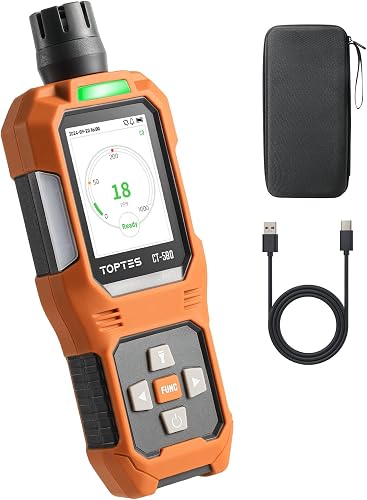
TOPTES CT-580 Portable Carbon Monoxide Detector: Best for travel and spot checks
- DDS sensor with 0.3-second response
- 0 to 1000 PPM range
- Vibration, light and sound alarms
- USB-C rechargeable
It reads CO in real time on a color screen and alerts with sound, light and vibration. A rechargeable battery and USB-C port make it easy to pack for hotels or job sites.
Pros
- Fast 0.3-second response
- Three alarm types
- Bright color display
- Built-in flashlight
Cons
- Meant for manual checks, not all-night home watch
- Higher price tier than simple alarms
This is a handheld CO meter rather than a wall alarm. A DDS sensor responds in about 0.3 seconds and reads concentrations from 0 to 1000 PPM on a color TFT screen.
Use it to check a hotel room, a camper, a boat cabin or a workspace before you trust the air.
Three alarm modes fire at once when CO reaches a threshold: a light, a sound and a vibration. That makes it useful in noisy places or where you can't hear a siren, like a machine shop or a running generator.
The rechargeable battery charges over USB-C, and the package includes a protective case and cable. A built-in flashlight and adjustable screen brightness add to its travel-friendly design.
It also stores alarm history and offers zero and standard gas calibration settings for professional use. That puts it in a different class from a simple home alarm.
The trade-off is its role. It is a manual inspection tool for spot checks, not a set-and-forget alarm for all-night protection.
Pair it with a fixed alarm at home and take it on the road.
Buy it for travel, rentals and job-site checks. Skip it if you want one alarm mounted on the wall and forgotten.
Siterlink Carbon Monoxide Detectors Plug: Best plug-in for bedroom outlets
- AC plug-in with 10-year battery backup
- Electrochemical sensor
- Foldable plug
- Soft breathing status light
The foldable plug goes straight into a wall outlet, and a 10-year backup battery keeps it live during a blackout. Its breathing status light is designed not to bother sleepers.
Pros
- 10-year backup battery
- Compact foldable plug
- Quiet status light
- Easy no-tool setup
Cons
- No smoke detection
Bedroom outlets are where this one shines. It plugs straight into a standard outlet, and its 10-year backup battery keeps it running through a blackout.
The foldable plug packs flat for travel to a hotel or a relative's house.
The electrochemical sensor is tuned to limit false alarms, and the status light is a soft breathing glow meant to mimic human breathing so it doesn't keep you awake. A steady green LED confirms power.
Setup is unfold, plug in and go. There is no bracket, no screws and no wiring, which makes it the quickest install on this list.
Its 10-year backup is a real advantage over the 9-volt backup in the Kidde plug-in.
It is CO only. If you want smoke covered too, the X-Sense SC07 or the Heiman combo does both.
Buy it for a bedroom or hotel room where the outlet is right there. Skip it if you need smoke detection from the same device.
X-Sense Smoke Detector Carbon Monoxide Alarm Combo: Best multi-pack for covering every level
- Three alarms per pack
- 10-year sealed lithium battery
- Photoelectric smoke and CO sensors
- Large 5.7-inch bracket
A three-pack puts a smoke and CO alarm on each floor without buying separate units. The oversized bracket hides old screw holes from alarms you are replacing.
Pros
- Covers three locations in one buy
- 10-year sealed battery
- Large bracket covers old holes
- Self-test every 60 seconds
Cons
- Standalone units, not linked
- No CO-specific readout details beyond the LCD
This three-pack is the practical way to cover a house floor by floor. Each unit combines a photoelectric smoke sensor with a CO sensor and runs on a sealed 10-year lithium battery.
You get three alarms per order.
The oversized 5.7-inch bracket covers more wall than a standard small bracket, so it hides old screw holes and ceiling stains from the alarms you are replacing. That matters when you upgrade a whole house at once.
A built-in self-test checks the sensors, electronics and battery every 60 seconds. The LCD stays dark in standby and lights up only for an alarm or test, so it won't glow in a bedroom at night.
The trade-off is the same as the SC07: these are standalone units. They do not interconnect, so a CO event on the top floor won't set off the alarm in the basement.
For linked alarms, look for the XP0H-WN.
Buy it when you need several alarms and want one order. Skip it for a single-room setup or if you need interconnection.
SITERWELL Carbon Monoxide Detector 7 Year Product: Best for a simple battery CO alarm
- Electrochemical sensor
- LCD with real-time CO levels
- 3-color LED status
- Wall or free-standing
A battery CO alarm with a clear LCD and three-color status light, made to sit on a shelf or hang on a wall. It runs on two AA batteries for its stated product life.
Pros
- LCD shows CO level
- Works without an outlet
- Wall or tabletop use
- 3-year limited warranty
Cons
- No smoke detection
- Battery-powered only
A plain, readable battery CO alarm for a shelf or wall. The LCD shows real-time CO levels, and a three-color LED flashes red, green or yellow for alarm, power or fault.
It runs on two AA batteries, so no outlet is needed.
The electrochemical sensor is built to respond quickly to dangerous CO, and the alarm sounds at no less than 85 dB at 3 meters. It conforms to ETL standards, which gives you a recognized safety benchmark.
You can wall-mount it or stand it free on a shelf. That flexibility suits a garage or a family home where you want a backup CO alarm in a spot without an outlet.
The stated product life is 7 years, backed by a 3-year limited warranty. The AA batteries are meant to last the life of the detector.
The trade-off against the top picks is coverage: it is CO only and battery only. It won't warn about explosive gas like the Kidde, and it won't cover smoke.
Buy it for a simple, movable CO-only alarm. Skip it if you want gas or smoke detection as well.
Heiman Smoke Detector Carbon Monoxide Detector Combo: Best for landlords and rental units
- 10-year sealed battery
- Dual-beam photoelectric smoke sensor plus CO sensor
- 85 dB alarm
- Alarm Memory
A sealed-battery combo alarm that covers smoke and CO for a decade with no hardwiring. Alarm Memory flashes after an event so a landlord can see it was triggered.
Pros
- 10-year sealed battery
- Smoke and CO together
- Alarm Memory for landlords
- End-of-life warning
Cons
- Pricier than a plain CO alarm
- Standalone unit
This combo is aimed at landlords and property managers who need durable coverage without hardwiring. A dual-beam photoelectric smoke sensor pairs with an electrochemical CO sensor, and a 10-year sealed lithium battery runs the whole thing.
Alarm Memory is the feature that sets it apart for rentals. If an alarm went off while the unit was empty, the red LED keeps flashing every 20 seconds so you or a tenant can see it happened.
That helps with maintenance records and follow-up.
It meets UL 217 10th Edition and UL 2034 5th Edition and is CSFM approved. The housing is UL94 V-0 rated ABS+PC, built to resist heat and corrosion.
An 85 dB siren with a flashing LED gives audio and visual warning. The one-touch Test/Silence button makes routine checks easy.
The trade-off is cost and simplicity. It costs more than a CO-only alarm and does more than a renter may need.
For a single apartment, a plain CO alarm plus separate smoke alarms can be enough.
Buy it for rental units and multi-property owners. Skip it for a small single-room need.
Heiman Carbon Monoxide Detectors: Best small CO-only alarm for tight spots
- Figaro electrochemical sensor
- 10-year battery
- 85 dB alarm with LED
- Mini 70 mm body
A mini CO-only alarm about 70 mm across, so it fits where a bigger unit will not. A long-life lithium battery means no rewiring and no yearly swaps.
Pros
- Very small body
- 10-year battery
- Figaro sensor
- Wall, ceiling or desktop
Cons
- CO only, no smoke sensor
- Small display area
The smallest alarm here, at about 70 mm across, so it fits on a narrow wall strip, a shelf edge or a spot where a full-size unit looks bulky. A Figaro electrochemical sensor does the CO detection, and a 10-year lithium battery runs it.
The 85 dB alarm pairs with an LED for audio and visual warning. A one-touch Test/Silence button covers routine checks.
You can mount it on a wall or ceiling or set it on a desktop.
It meets UL 2034 5th Edition and is CSFM approved. The housing is UL94 V-0 flame-retardant ABS+PC, and the unit is built to resist corrosion and heat.
The mini size is the selling point. It disappears into a hallway or a garage corner where a bigger alarm would stand out.
The trade-off is that a small body means a small display area and no smoke sensor. It is a dedicated CO alarm, so pair it with smoke alarms elsewhere.
Buy it for tight spots and discreet coverage. Skip it if you need a readable display or smoke detection.
How these carbon monoxide detectors compare
The table lines up the key differences: power source, backup, sensor type and whether smoke or explosive gas is covered. Read across the row for the model you're considering.
| Product | Best for | Power | Sensor | Alarm | Our score |
|---|---|---|---|---|---|
| Kidde Carbon Monoxide Detector | gas appliances and furnace rooms | Plug-in with 9-volt backup | Electrochemical | 85 dB | 9.7 |
| Kidde Carbon Monoxide Detector | renters and tabletop placement | 2 AA batteries | Electrochemical | 85 dB | 9.6 |
| X-Sense Smoke Detector Carbon Monoxide Detector Combo | two-in-one for a whole home | 10-year sealed battery | 85 dB | 9.5 | |
| TOPTES CT-580 Portable Carbon Monoxide Detector | travel and spot checks | Rechargeable battery | Sound, light and vibration | 9.4 | |
| Siterlink Carbon Monoxide Detectors Plug | plug-in for bedroom outlets | AC plug-in with 10-year backup | Electrochemical | Audible | 9.2 |
| X-Sense Smoke Detector Carbon Monoxide Alarm Combo | multi-pack for covering every level | 10-year sealed battery | 8.8 | ||
| SITERWELL Carbon Monoxide Detector 7 Year Product | a simple battery CO alarm | 2 AA batteries | Electrochemical | 85 dB | 8.6 |
| Heiman Smoke Detector Carbon Monoxide Detector Combo | landlords and rental units | 10-year sealed battery | 85 dB | 8.3 | |
| Heiman Carbon Monoxide Detectors | small CO-only alarm for tight spots | 10-year lithium battery | Electrochemical | 85 dB | 8.1 |
Power is the first thing to check. Plug-in models like the Kidde KN-COEG-3 and the Siterlink need an outlet but often carry a backup battery.
Battery models like the Kidde AA unit and the SITERWELL go anywhere but need battery upkeep.
Coverage is the second. CO-only alarms are the simplest way to watch for carbon monoxide.
Combination units add smoke sensing and cut the number of devices on your ceiling.
Display matters more than people expect. A digital readout like the Kidde's or the SITERWELL's shows the CO level, which helps you judge whether to ventilate or leave.
A plain alarm only tells you something is wrong.
How we compared these carbon monoxide detectors
We compared the specs and features of each alarm against what a home buyer needs: a working CO sensor, a reliable power source, a loud alarm and coverage that matches the room. We weighed backup power, sensor type and extra detection.
We also looked at how each unit fits daily life. A plug-in alarm in a bedroom needs a quiet status light and a low profile.
A sealed-battery combo needs to install without wiring. A travel meter needs to be small and rechargeable.
Our score weighs specs, features and how each product fits what you're shopping for. One product, one score across the site.
What should you look for in a home carbon monoxide detector?
Start with a certified electrochemical sensor and a loud alarm, then match the power source to the room. A detector is only useful if it is installed, powered and heard, so choose one you will actually mount and maintain.
Look for UL 2034 certification on CO alarms. The Kidde, X-Sense and Heiman units here all carry it.
A recognized listing tells you the sensor and alarm were tested to a safety standard.
CO-only alarm or a smoke and CO combo?
A CO-only alarm is the simplest way to add carbon monoxide coverage. It costs less and does one job well.
Models like the SITERWELL and Heiman C1-S fit that description.
A combo unit covers smoke and CO in one device. The X-Sense SC07 and Heiman combo both do this on a sealed battery.
Choose a combo when you are replacing smoke alarms anyway and want fewer devices on the ceiling.
Plug-in or battery powered?
Plug-in models run continuously on mains power and use a backup battery for outages. The Kidde KN-COEG-3 and the Siterlink fit this pattern.
They suit a home with a free outlet in the right spot.
Battery models go anywhere and keep working when the power fails. The Kidde AA unit and the SITERWELL are battery only.
They suit renters, travel and rooms without an outlet.
Do you need a digital display?
A digital display shows the CO level the alarm is sensing. That helps you decide whether to open windows, leave the house or call for help.
The Kidde, SITERWELL and TOPTES units all show readings.
A plain alarm only sounds. That is fine for a backup unit or a spot where the display would be hard to read.
The core job is the alarm, not the readout.
How many detectors does a home need?
One per level is the baseline, plus one near the bedrooms. Add one in any room with a fuel-burning appliance.
A multi-pack like the X-Sense three-pack covers those spots in one order.
Check the guide to whether all homes need a carbon monoxide detector for the full room-by-room plan. Any home with a gas furnace, water heater, fireplace or attached garage should have at least one.
How do you keep a detector working?
Test each alarm monthly with its test button and replace it at the end of its rated life. Keep the vents clear of dust and furniture.
Our guide on how to test a carbon monoxide detector walks through the button test and what each beep means.
Replaceable batteries need swapping on schedule. Sealed 10-year units need no battery changes but do need replacement when the end-of-life signal sounds.
A detector past its service life is not protection.
The best carbon monoxide detector for home: which to buy
For most homes, buy the Kidde KN-COEG-3. It covers carbon monoxide and explosive gas, plugs in, and keeps watching on a 9-volt backup during a power outage.
The digital display and peak memory make it easy to see what happened.
Choose the X-Sense SC07 if you want smoke and CO in one sealed-battery alarm. Pick the Siterlink if your bedroom outlet is the natural spot.
The TOPTES CT-580 is the one to pack for hotels and travel.
If you are outfitting several rooms at once, the X-Sense three-pack covers more ground per order. For a rental property, the Heiman combo's Alarm Memory gives you a record of events.
For a tiny spot, the Heiman C1-S fits where bigger alarms won't.
Whichever you choose, the best carbon monoxide detector for home is the one that is certified, powered and tested every month. Install it before you need it.
Our top 3 picks at a glance
-
1
Best for gas appliances and furnace rooms
Kidde Carbon Monoxide Detector
9.7/10 our score
See it on Amazon -
2
Best for renters and tabletop placement
Kidde Carbon Monoxide Detector
9.6/10 our score
See it on Amazon -
3
Best two-in-one for a whole home
X-Sense Smoke Detector Carbon Monoxide Detector Combo
9.5/10 our score
See it on Amazon
Frequently asked questions
Where should I put a carbon monoxide detector in a home?
Put one on every level, near bedrooms and outside sleeping areas. Add one in any room with a fuel-burning appliance, like a furnace, water heater or attached garage.
Place plug-in models at a working outlet and keep them out of dead-air corners.
Do I need both a smoke alarm and a CO alarm?
Yes. Smoke and carbon monoxide are different dangers and need different sensors.
A combination unit like the X-Sense SC07 covers both in one device, while a CO-only alarm needs separate smoke alarms nearby.
How long do carbon monoxide detectors last?
Most CO alarms are rated for 7 to 10 years of service. Sealed-battery units like the Heiman C1-S and X-Sense SC07 are built to match that life, while models with replaceable AA or 9-volt batteries last as long as the sensor does.
Does a carbon monoxide detector work during a power outage?
Only if it has battery backup. The Kidde KN-COEG-3 uses a 9-volt backup and the Siterlink has a 10-year backup, so both keep watching when the power fails.
Battery-only alarms run without mains power at all.
What does it mean when a CO detector chirps five times?
A five-chirp pattern usually signals an end-of-life or sensor fault condition rather than carbon monoxide. Check the unit's manual for the exact meaning and replace the alarm if it has reached its rated life.
Our guide to a carbon monoxide detector chirping 5 times covers the common causes.


